In the first two articles of this series, we examined how noise quietly undermines cognitive performance and how chronic exposure contributes to serious physical and mental health consequences. The final question is no longer whether acoustics matters – but how intelligently workplaces respond to it. How do we design workplaces that solve this problem?
If unmanaged sound is an obstacle to focus and health, then acoustic design is not an optional add-on-it is central to performance, well-being, and future-ready workplaces.
The answer does not lie in silence, behavioural rules, or cosmetic acoustic fixes.
It lies in designing acoustic systems that evolve with how spaces are actually used.
Modern workplaces are dynamic. Their acoustic infrastructure must be as well.
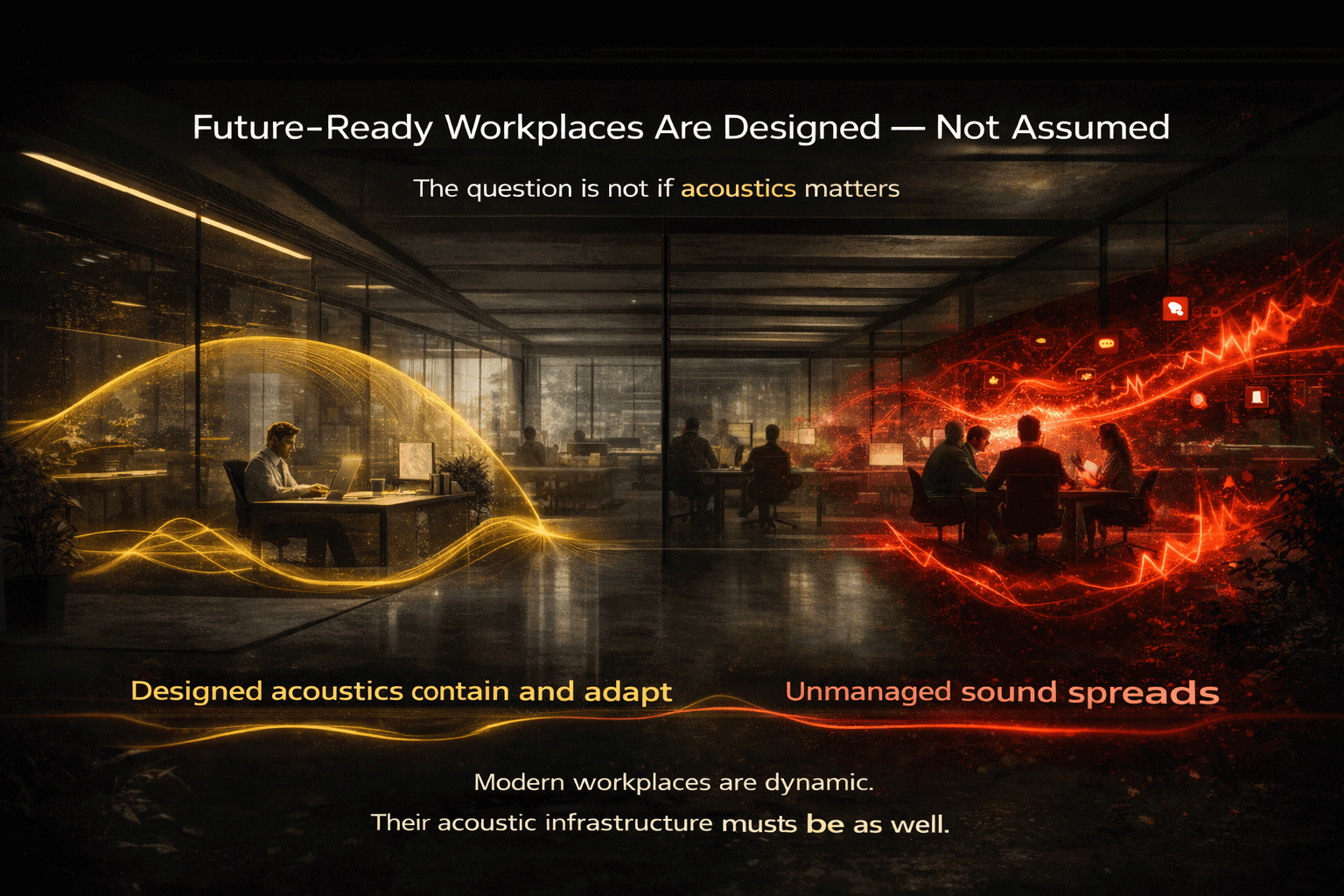
Understanding Architectural Acoustics
Architectural acoustics is the science and engineering of achieving effective sound environments within buildings. It encompasses how sound is absorbed, reflected, transmitted, and perceived, and is a fundamental design discipline alongside lighting and environmental comfort (Wikipedia).
Poor acoustics isn’t just about loudness – it’s about speech intelligibility, reverberation, and sound propagation – all of which determine how people perceive and respond to environments.
Standards such as BS EN ISO 22955:2021 and design guides emphasise controlling reverberation, sound absorption, and speech attenuation to create productive workplaces (ekko Acoustics).
The Modern Workplace Dichotomy
Contemporary workplaces aim to balance collaboration with focused work. However, open-plan layouts often result in mixed acoustic conditions where speech and ambient noise travel freely, negatively affecting concentration and comfort.
Research shows that distraction from speech and nearby conversations significantly impairs cognitive performance and increases mental fatigue, even when workers try to ignore it (ecophon.com).
Effective acoustic design does not seek to eliminate sound. Rather, it aims to manage it intelligently so that spaces support both social interaction and cognitive recovery.
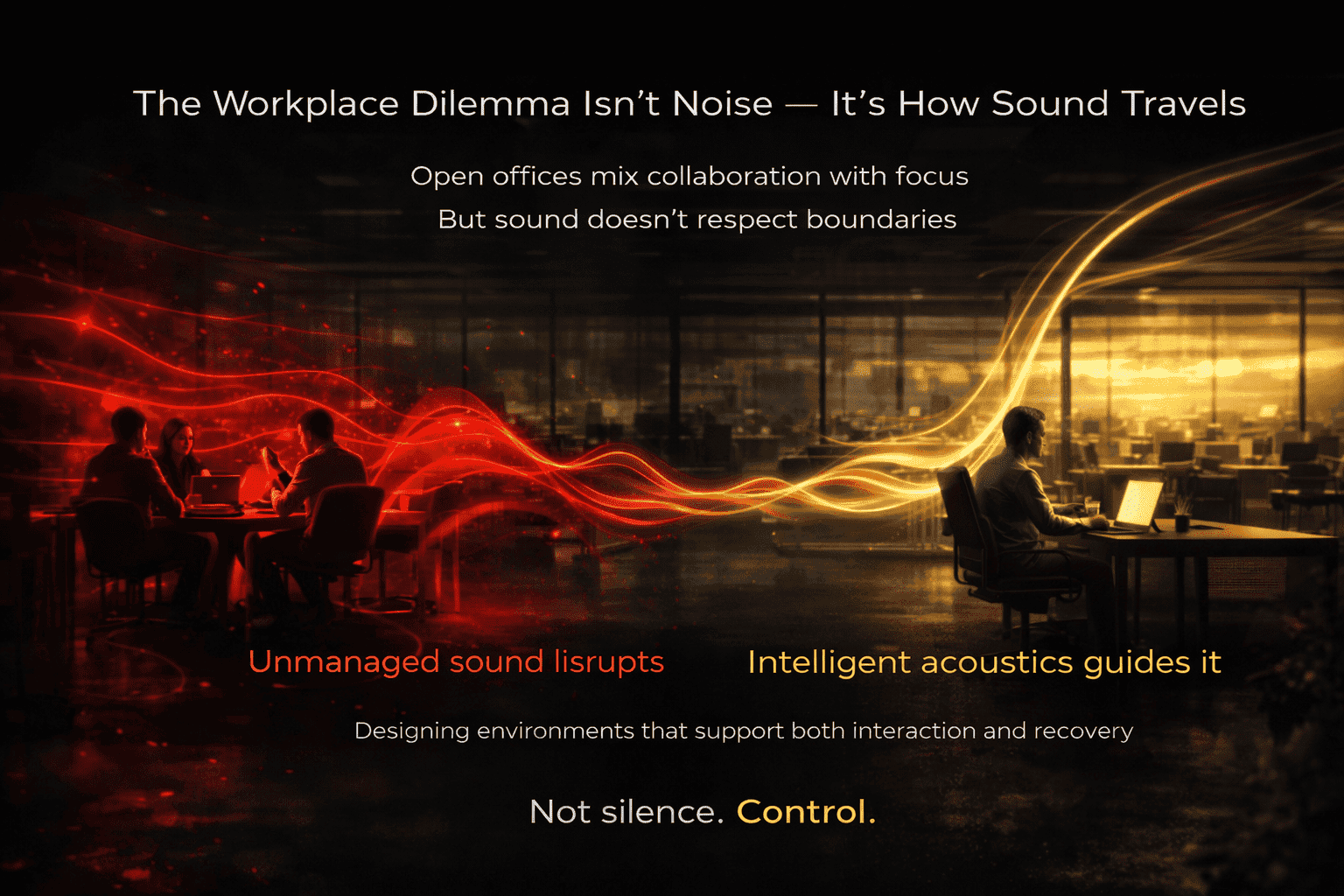
Design response, future-ready workplaces | IQUBX
Acoustic Zoning-Designing for Cognitive States
The most effective workplaces are layered acoustic environments-each tailored to different human needs.
-
Focused Work Zones
Designed to support deep thinking with:
- Controlled sound transmission
- Predictable acoustic conditions
- Limited speech intrusion
This typically involves high-performance partitions, controlled enclosures, and targeted sound insulation strategies.
2. Collaboration Zones
These spaces promote discussion and idea exchange while containing sound within a designated area. Acoustic design treatments like absorptive materials and zoning reduce spillover into focus zones.
3. Transitional & Social Spaces
Breakout areas and lounges act as acoustic buffers, absorbing and diffusing sound between work modes.
This layered zoning approach correlates with cognitive needs-focus, interaction, and recovery-and is supported by research showing that balanced acoustic environments improve comfort, job satisfaction, and wellbeing (ekko Acoustics).
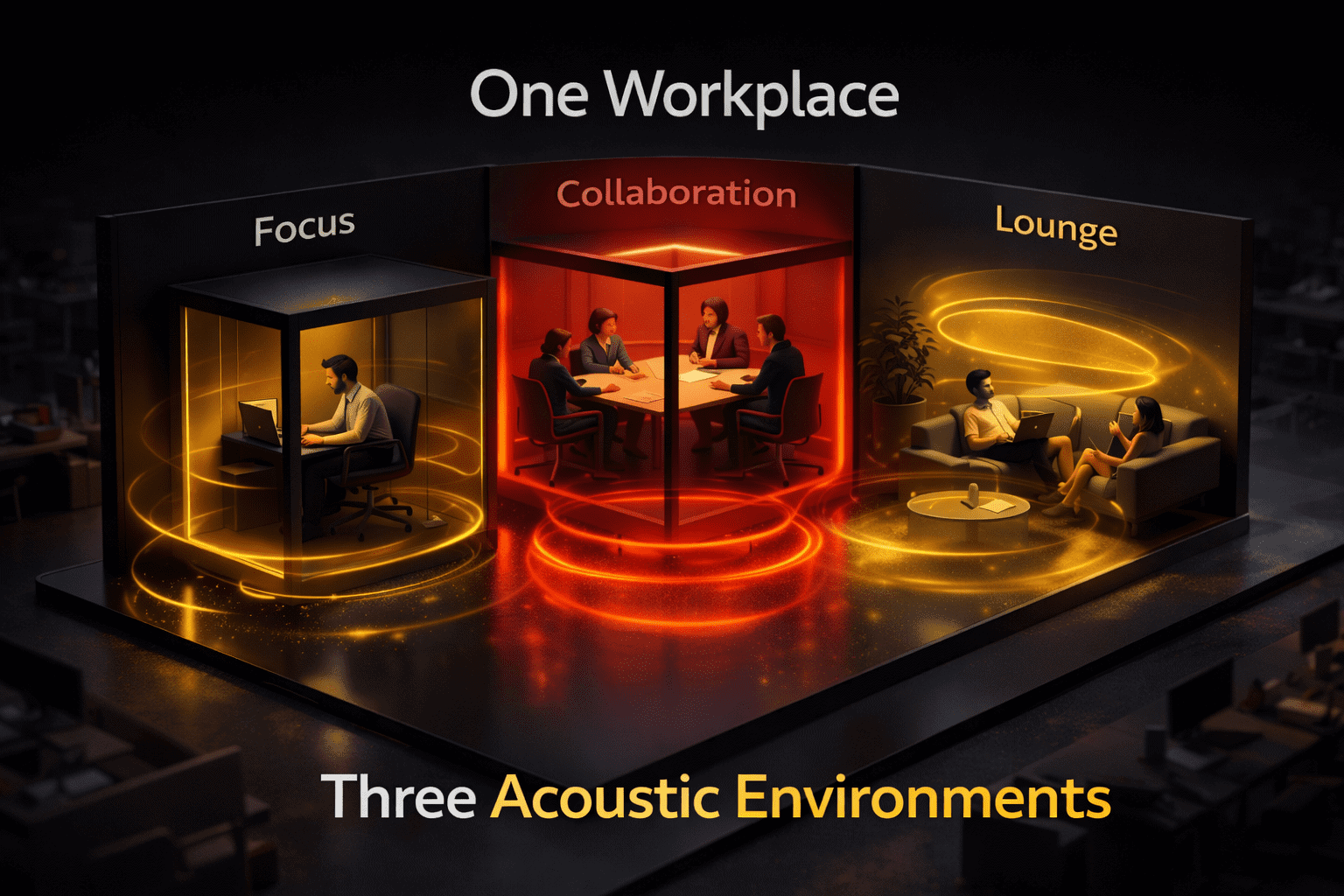
Beyond Absorption-A Systems Approach
Traditional acoustic design often emphasises absorptive materials alone. While these are critical, they are not sufficient in isolation. Effective acoustic environments combine:
- Absorption (reducing reverberation and echo)
- Blocking & insulation (preventing sound transfer between zones)
- Predictable acoustic envelopes (limiting sudden sound changes)
Acoustic furniture, partitions, and surfaces are more effective when integrated into a systems approach to how sound travels and is experienced in a space.
For example, strategic partitioning and zoning have been shown to reduce noise disruptions and improve workflow efficiency significantly when combined with absorptive treatments and spatial planning (rubenius.in).
The Reality Most Offices Ignore: Acoustic Needs Change Over Time
One of the biggest oversights in workplace design is the assumption that acoustic requirements are fixed at the time of fit-out.
In practice, they rarely are.
Over the life of a workplace:
- Focus zones become meeting spaces
- Collaboration areas demand confidentiality
- Teams expand, contract, or reorganise
- Hybrid work increases video calls and speech density
- Expectations of privacy and well-being rise
What was “good enough” acoustically in year one often becomes inadequate by year three.
This exposes a core flaw in conventional approaches:
most acoustic solutions are designed as permanent answers to temporary assumptions.
What Makes Acoustic Design Future-Ready
Future-ready workplaces require acoustic systems, not isolated products.
A true system is defined by three characteristics:
- High baseline performance from day one
- Adaptability to changing layouts and functions
- Upgradability without demolition, waste, or disruption
This represents a fundamental shift-from fixed partitions to evolving acoustic infrastructure.
Rethinking Glass: Transparency Without Acoustic Compromise
Glass dominates contemporary office design for daylight, openness, and psychological transparency. Yet it is still widely (and incorrectly) perceived as acoustically inferior.
In reality, high-performance acoustic glass partitions, when engineered as complete systems, can deliver both openness and serious sound insulation.
The performance of such systems depends not on glass alone, but on:
- Glass composition and thickness
- Symmetry vs asymmetry
- Framing geometry
- Sealing strategy
- Junction detailing with floors and ceilings
When these are designed together, glass becomes a high-performance acoustic material.
Baseline Performance Matters-and So Does Headroom
Within this context, systems such as IQUBX’s GP1800 / GP18100 high-acoustic glass partition series illustrate what future-ready design looks like.
Under standardised laboratory testing conditions (as defined by ASTM E90 / ISO 10140 methodologies for airborne sound insulation), the GP1800-series has demonstrated reported baseline performance levels such as:
- STC 45+ with a single 12 mm toughened float glass
- Up to STC 54 with double 12 mm toughened float glass
Critically, the same system architecture is designed to accommodate higher-performance configurations without system replacement, including:
- Asymmetric combinations of 12 mm toughened glass with 13.5 mm laminated glass
- Advanced assemblies using 24 mm DGU (double-glazed units)
These configurations are expected to push performance significantly beyond baseline values, while remaining within the same partition framework.
This is possible because performance is not being “forced” through glass thickness alone, but enabled through multi-chamber, flexiwall-inspired structural design, which improves:
- Mass–air–mass behaviour
- Damping
- Acoustic decoupling within the system
(Sound insulation performance referenced in accordance with ASTM E90 / ISO 10140 test standards; field performance will vary based on installation and junction conditions.)
Why Upgradability Is a Strategic Requirement
Upgradability is not a technical indulgence.
It is a strategic, economic, and sustainability imperative.
Acoustic expectations almost never decrease-they increase due to:
- Greater confidentiality needs
- Denser collaboration
- Higher video-conferencing intensity
- Improved awareness of well-being
Systems that cannot be upgraded lock organisations into:
- Demolition
- Material waste
- Operational downtime
- Repeated capital expenditure
Future-ready acoustic systems are designed so performance can be enhanced, not replaced-aligning with both operational agility and sustainability goals.
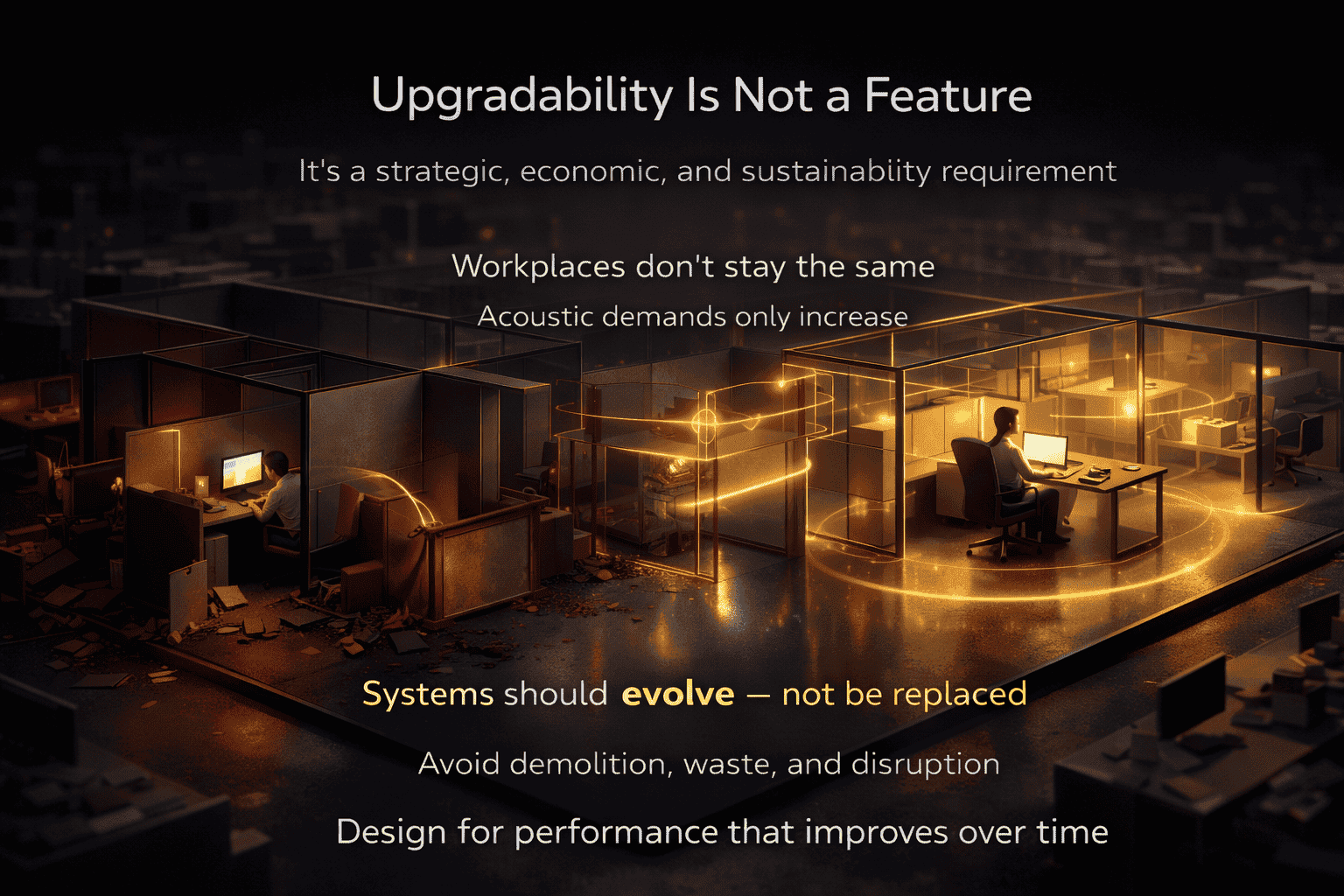
Pods: Precision Acoustic Tools, Not Generic Furniture
Pods are often treated as off-the-shelf furniture. This is where many deployments fail.
Pods are most effective when understood as micro-architectural acoustic systems.
Well-designed pods:
- Reduce surrounding office noise to stable, non-jarring background levels
- Enable focused work, confidential calls, and sensitive meetings
- Create islands of acoustic predictability within dynamic environments
Equally important is custom sizing.
One-size-fits-all pods rarely align with:
- Real user density
- Specific functional use (focus vs meetings vs calls)
- Spatial constraints of evolving layouts
Custom-dimensioned pods, integrated with partitions and ceiling strategies, perform dramatically better-both acoustically and experientially.
Acoustic Zoning as a Living Framework
Future-ready workplaces treat acoustic zoning as a living system, not a static plan.
This includes:
- Focus zones protected by high-performance partitions
- Collaboration zones acoustically tuned, not acoustically exposed
- Pods deployed intentionally, not randomly
- Ceilings and absorptive elements working in concert with partitions
Predictable sound behaviour is the goal-because predictability is what the human brain needs to sustain focus and reduce stress.
Where IQUBX Fits In
At the intersection of architecture, material science, and systems thinking is IQUBX.
IQUBX’s role is not to sell isolated products, but to enable designers and organisations to apply acoustic intelligence strategically and engineer future-ready acoustic systems and that combine:
- High-baseline acoustic performance glass partitions
- Upgrade-ready glass and Demountable solid partitions systems
- Customisable Modular acoustic pods
- Integration with ceilings, layouts, and zoning logic
IQUBX helps resolve the collaboration–concentration dilemma without compromising openness or flexibility.
This is not about quieter offices-it is about intelligently engineered soundscapes that support both performance and well-being.
The Future of Workplace Design
The future of work will be shaped not just by technology or policy, but by environments that support human cognition, health, and experience.
Acoustic design is no longer a nice-to-have. It is an essential dimension of workplace strategy.
Workplaces will continue to change.
The question is whether their acoustic infrastructure is designed to change with them or resist them.
Future-ready design recognises that:
- Focus is fragile
- Health is cumulative
- Space usage is fluid
Acoustic systems that are adaptable, upgradable, and performance-driven are no longer optional.
They are foundational infrastructure for modern work.
When sound is designed with intent, clarity follows-not by enforcement, but by design.
Standards & Reference Frameworks
- ASTM E90 – Standard Test Method for Laboratory Measurement of Airborne Sound Transmission Loss
- ISO 10140 (Parts 1–5) – Laboratory measurement of sound insulation of building elements
- ISO 717 – Rating of sound insulation (STC / Rw derivation)
(Performance values referenced are laboratory test results under standardised conditions; site performance depends on installation quality and junction detailing.)
Related Posts

About The Author

Amit Garg
CEO, IQUBX - Amit is an architect, Product Designer, Entrepreneur, ino-ventor, based in New Delhi, capital of India. Having an experience of more than 20 years in field of architecture. Subscribe to regular updates by IQUBX