In today’s fast-changing world of work, productivity conversations are dominated by technology and time management tools. What rarely gets center stage is sound-not just volume, but how it interacts with the human brain.
Noise is not merely a nuisance. It is an environmental stressor that continuously interferes with cognition, drains mental resources, and erodes the very foundation of knowledge work. As offices become denser, more open, and increasingly hybrid, unmanaged acoustic environments are exposing a silent but systemic risk to performance and well-being.
Why Noise Is Not Just a “Sound Problem”
The human auditory system does far more than detect volume. It continually monitors the environment for change, prioritising unexpected sounds that might signal threat or novelty. This evolutionary wiring has consequences in contemporary workplaces.
Cognitive research shows that exposure to background sound-including speech and unpredictable auditory variations-is linked with reduced performance in working memory, attention, and task focus compared with quieter conditions (PMC). This phenomenon is often referred to as the irrelevant sound effect (ISE)-a reduction in cognitive performance in the presence of background noise that the listener is trying to ignore (Taylor & Francis Online).
In other words:
- Quiet focus is not the absence of sound
- It is the absence of distraction from sound that draws attention
Not All Sound Is Created Equal
One of the most important insights from cognitive science is that the character of sound matters more than volume alone.
🟡 Continuous, Predictable Sound (e.g., White Noise)
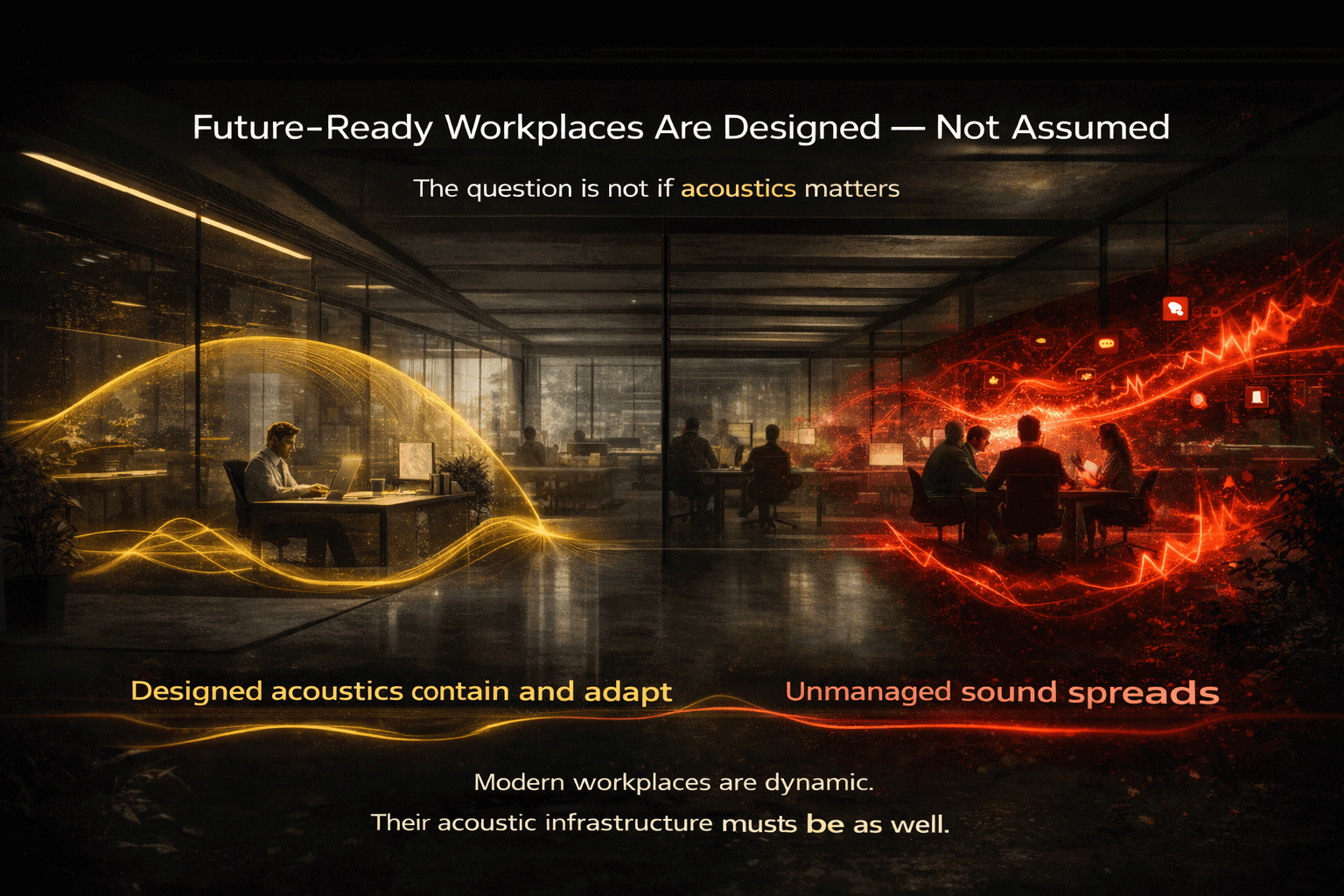
Steady sound environments-similar to what is created by broadband or white noise-can be easier for the brain to filter out and adapt to over time. Research in controlled cognitive settings suggests that consistent background sound can sometimes stabilize attention, reducing internal distraction and lowering stress markers associated with unpredictable stimuli (Nature).
🔴 Unpredictable, Non-Periodic Noise
By contrast, sudden, variable noises-shifting conversations, abrupt tones, multi-talker speech-pull the brain’s attention away from the task at hand. This is not subjective discomfort; it is a measurable neurological cost of constantly re-allocating cognitive resources to sound monitoring.
Studies confirm that fluctuating and task-irrelevant sounds disrupt memory encoding and cognitive processing more than steady sound patterns (PMC)

The Open-Office Paradox
Open-plan office design has been widely embraced for its potential to enhance collaboration, transparency, and team energy. Yet its acoustic implications are often overlooked.
In open environments:
- Sound travels easily across workstations
- Conversations and notifications intermingle
- Predictable acoustic zones are rare
Researchers have found that speech intelligibility and background conversations are among the strongest distractors in office settings, significantly degrading cognitive performance compared to acoustically insulated conditions (PubMed).
Even moderate levels of unpredictable noise-well below painful thresholds-force the brain to filter and refocus repeatedly, increasing mental strain.
Why This Matters Beyond Annoyance
For knowledge workers, focus isn’t just a luxury-it is a resource-limited cognitive function. Every involuntary attention shift consumes mental bandwidth. Over time, this contributes to:
- Tasks taking longer to complete
- Increased error rates
- Slower decision-making
- Accumulating stress and fatigue
Noise isn’t merely an environment quality issue-it is a productivity constraintwith measurable impact on outcomes that matter to both individuals and organisations.

The Architectural Implication
If unpredictable noise undermines cognition, then acoustic design is not an afterthought-it is a strategic performance parameter.
Architectural planning has traditionally prioritised visual flow, zoning, and collaboration. But without intelligently engineered acoustic spaces-whether through appropriate partitioning, absorption materials, or spatial configuration-design overlooks how people think and focus within those spaces.
Acoustic intelligence must be integrated into workplace design just as light, ergonomics, and circulation are considered fundamental.
Related Posts

About The Author

Amit Garg
CEO, IQUBX - Amit is an architect, Product Designer, Entrepreneur, ino-ventor, based in New Delhi, capital of India. Having an experience of more than 20 years in field of architecture. Subscribe to regular updates by IQUBX